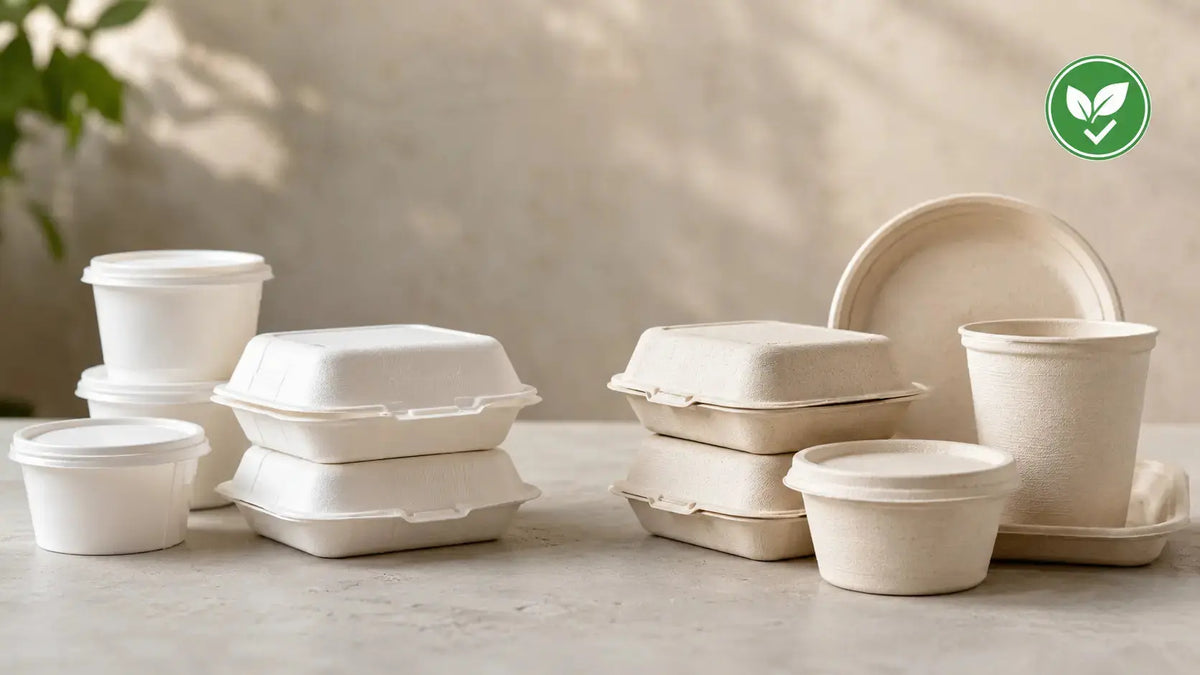
"Eco-friendly." "Earth-conscious." "Green." Walk through any wholesale catalog of disposables and you'll find these claims on nearly every page. But here's the uncomfortable truth for food service operators: most of these terms have no legal definition, no testing behind them, and no third-party verification.
And when an unverified claim gets challenged — by a customer, a journalist, or a regulator — it's not the supplier's brand that takes the hit. It's yours.
For restaurants, caterers, and wholesale buyers, certifications aren't a marketing nicety. They're risk management.
Greenwashing is now a business risk, not just a PR problem
Regulatory scrutiny of environmental claims is intensifying across the United States. The FTC's Green Guides set expectations for substantiating marketing claims, and state-level enforcement is growing alongside expanding single-use plastic legislation. Meanwhile, consumers are more skeptical than ever: they actively look for proof behind sustainability messaging, and they punish brands that get caught overstating it.
The exposure compounds in food service. If your menu says "compostable packaging" but your cutlery is merely "biodegradable plastic" with no certification, you're making a claim you can't substantiate — in writing, to every customer, every day.
Why "Biodegradable" is the most dangerous word in your supply chain.
Technically, almost everything biodegrades eventually — even conventional plastic, over centuries. That's why "biodegradable" without a timeframe or standard is effectively meaningless, and why some states restrict its use on packaging altogether.
"Compostable," by contrast, can be verified. A certified compostable product has been laboratory-tested to break down within a defined timeframe, under defined conditions, leaving no toxic residue. That distinction — testable versus vague — is precisely what separates a defensible claim from a liability.
The certification that actually protect you
When evaluating suppliers, food service buyers should treat these as non-negotiable. BPI (Biodegradable Products Institute) is the leading North American certification, verifying that products meet ASTM D6400 and D6868 standards for commercial compostability. ASTM standards themselves are the scientific benchmark: they define how products must perform in testing. For products intended for backyard disposal, OK compost HOME (TÜV Austria) certifies breakdown under home composting conditions.
If a supplier can't produce current certificates for the exact SKUs you're buying — not just their brand in general — that's your signal to walk away.
Certifications open doors, not just close risks
There's an offensive play here too. Universities, hospitals, stadiums, and corporate campuses increasingly require certified compostables in their RFPs — an uncertified product line can disqualify your bid before pricing is even discussed. Certified packaging also strengthens ESG reporting, supports zero-waste venue mandates, and gives your marketing team claims they can defend with documentation instead of adjectives.
In other words: the same certificate that protects you from a greenwashing accusation helps you win the institutional contract.
What to ask your supplier this quarter
Make it part of your procurement checklist: Which certifications does each SKU carry? Can you provide current certificates on request? Do your products meet ASTM D6400/D6868? How do you support customers with compliance documentation for RFPs and audits?
At wecare, certifications aren't fine print — they're the foundation of the product line, with documentation ready for every audit, bid, and customer question.
Green claims are easy. Proof is what protects your brand. In a market where regulators, institutions, and customers all demand verification, certified compostable disposables turn sustainability from a reputational risk into a competitive credential. Before your next order, look past the leaf on the label — and ask for the certificate behind it.